Author: Diego Romero

Leads paid media and performance strategy at ATRIUM. He specializes in structured Google Ads systems for luxury home service and construction businesses. Diego holds certifications in Google Ads (Search & Display), Google Analytics, Meta Media Buying, HubSpot Inbound Sales, and Hootsuite Academy

How to Tell If Your Marketing Is Broken or Just Seasonal

Your marketing is probably not broken. In February, a chimney and fire safety business will almost always see fewer inbound leads than it did in October or November. That is not a system failure — that is the industry. The harder question is whether your slower numbers reflect normal seasonal compression or a real problem you need to fix.

The answer depends on what you are measuring and when.


Why This Confusion Happens in February

The chimney and fire safety industry has one of the most pronounced seasonal curves in home services. Demand concentrates in the fall, driven by the practical reality that homeowners think about their fireplaces when temperatures drop. By February, that urgency has largely passed. Homeowners who were going to schedule a sweep or inspection before the heating season either did it or decided to wait until next fall.

This timing creates a predictable gap between what your marketing is producing now and what it produced three to four months ago. That gap often triggers doubt. When leads slow down, the instinct is to assume something is wrong — with the ads, the website, the agency, or the budget.

Sometimes something is wrong. But in February, the more likely explanation is that you are in the low-demand window of a highly seasonal business.

There are also structural factors making this more complicated than it was a few years ago:

Ad costs have increased. Running paid campaigns in competitive markets costs more than it did. Cost per lead has gone up across nearly every channel, which means the same budget that produced a certain volume of leads 18 months ago will produce fewer today.

Buyer behavior has shifted. Homeowners research more before they call. They compare reviews, look at websites, and sometimes sit on a problem for weeks before reaching out. The path from awareness to booked job is longer than it used to be.

Trust signals carry more weight. A business without strong reviews, a clear service area, and a professional online presence loses ground to competitors who have invested in those basics — regardless of how good the actual service is.

All of this means that even in a slow month, the underlying health of your marketing setup matters.


What Most Businesses Get Wrong About Slow Periods

The most common mistake is treating every slow month as a signal to do something different. Add a promotion. Change the ad copy. Switch platforms. Increase the budget. These reactions feel productive, but they often introduce noise into a system that was already working adequately.

The other common mistake is the opposite: assuming that because it is February, nothing can be done and nothing should be looked at. Slow months are actually the right time to examine whether your system is set up to capture demand when it returns.

A few specific misunderstandings worth naming:

Lead volume and lead quality are not the same thing. A business that ran aggressive promotions in October may have generated a lot of calls that did not convert into profitable jobs. High volume is not the same as healthy marketing. If you are measuring success primarily by how many leads came in, you may be missing what actually matters.

Month-over-month comparisons are not useful for seasonal businesses. Comparing February to November will always look alarming. The meaningful comparison is February this year versus February last year. If year-over-year numbers are declining, that warrants attention. If they are roughly flat or slightly up, you are likely in normal seasonal territory.

Marketing does not cause seasonality. No campaign change will make homeowners want chimney service in February the way they want it in October. Marketing can influence share within existing demand, but it cannot manufacture demand that is not there.


What Actually Matters at a Strategic Level

When demand is compressed, the businesses that come out ahead are the ones whose fundamentals are solid — not the ones who reacted the fastest.

The strategic priorities that hold up regardless of season are:

Visibility when demand is active. The question is not whether you are running something in February. The question is whether you will be positioned to capture demand when it returns in late summer and fall. That positioning takes months to build. If your online presence, review count, and search visibility are weak right now, that is a real problem — but it will not show up as missed leads until the season turns.

Messaging that matches where the buyer is. In February, a homeowner who is thinking about chimney service is often doing so because something went wrong — a smell, a sound, a concern after a cold snap. Messaging that leads with safety and urgency is more relevant than messaging built around fall preparation. This is not a major overhaul. It is an awareness of what the buyer’s mindset actually is right now.

A system that captures and follows up on every lead. In slow months, every lead counts more. If your phone goes unanswered, if follow-up is inconsistent, or if your booking process creates friction, you are losing a higher percentage of the available demand than you would in a high-volume month. Plugging those gaps matters more in February than adding more spend.


What to Focus On Right Now

Rather than reacting to slow numbers, the more useful exercise is a structured look at whether your marketing foundation is actually sound.

Budget clarity. Do you know your actual cost per booked job — not cost per lead, but cost per completed, paid job? If not, you do not have enough information to make good decisions about where to spend. This is worth calculating before you change anything.

Lead quality review. Look at the leads that came in during your last peak season. What percentage converted? What was the average job value? If your conversion rate was low, the problem may not have been lead volume — it may have been lead quality or follow-up.

Messaging audit. Read your website and ad copy as if you were a homeowner who just noticed something concerning about their fireplace. Does your messaging speak to that person? Or does it lead with your company history and service list?

Trust signals. Count your Google reviews and note how recent they are. Look at your response rate to reviews. Check whether your website communicates clearly what you do, where you do it, and why someone should trust you. These are the things a prospective customer evaluates before they ever call.

Off-season positioning. Is there a legitimate reason for homeowners to engage with your business in February? Dryer vent cleaning, air quality concerns, and gas fireplace inspections are real services with real demand in winter. Not every business should pursue these, but it is worth knowing whether you are leaving reachable revenue unaddressed.


What ATRIUM Observes Across Similar Businesses

Working with chimney and fire safety businesses alongside other premium home service and specialty construction companies, ATRIUM sees this pattern regularly: owners who have been in business for years and are doing a lot of things right still end up in February wondering if their marketing has stopped working.

In most cases, it has not. But the slow period reveals gaps that high volume masked during peak season — follow-up lapses, trust signal weaknesses, or a mismatch between what the marketing promises and what the booking process delivers.

The businesses that grow consistently are not the ones that spend the most or react the fastest. They are the ones who use the slow months to get clear on what is actually working and build the foundation that lets them dominate when demand returns.


Frequently Asked Questions

My leads dropped 40% from November to now. Should I be worried? Not necessarily — not yet. A 40% drop from November to February is consistent with normal seasonal patterns in chimney and fire safety. The more relevant question is how February this year compares to February last year. If that year-over-year number is also down significantly, then you have something worth investigating.

How do I know if my ad spend is actually working? Track cost per booked job, not cost per click or cost per lead. If you can calculate what you spend to acquire one completed, paid customer, you can make rational decisions about where to invest. If you cannot calculate that number, that is the first thing to fix.

Is it worth increasing my budget during slow months? It depends on what you are trying to accomplish. If you are trying to generate more immediate jobs, the ROI in a low-demand month will likely be weaker than in peak season. If you are investing in visibility and positioning for fall, that can make sense — but it is a different kind of spend with a longer payback window.

My competitor seems to be everywhere right now. Should I match their spend? Not automatically. Visibility does not equal profitability. Your competitor may be spending aggressively at a loss, or they may be building long-term positioning. Without knowing their numbers, mimicking their spend is not a strategy. Focus on your own cost per booked job and whether you are capturing the leads that are available.

What is the one thing I should actually do differently this February? Audit your lead follow-up process. In a slow month, the leads you are already getting are more valuable. If any of them are falling through the cracks — unanswered calls, slow callbacks, no follow-up after an estimate — fixing that will have a more immediate impact than any change to your advertising.


A Note from ATRIUM


If you are unsure whether what you are seeing is seasonal noise or a real structural problem, that is a reasonable place to be. It usually takes a clear look at your numbers — not gut feel — to know the difference.

ATRIUM works with chimney and fire safety businesses and other premium service companies to bring that kind of clarity. If you would like to talk through what your numbers are actually telling you, we are happy to have that conversation.

home service marketing team strategy planning

Google Ads vs Meta Ads for Home Service Companies: What Actually Works?

Most home service business owners ask the same question:

“Should we invest in Google Ads or Facebook ads?”

It sounds like a platform decision.

But it’s actually a strategy decision.

Understanding Google Ads vs Meta Ads for home service companies is the difference between buying random leads and building a predictable marketing system.


The Biggest Mistake Business Owners Make

Many companies treat advertising like a switch.

Leads slow down → turn ads on.
Busy season → turn ads off.

The result?

Unstable revenue.
Unpredictable scheduling.
Constant stress.

Ads are not the strategy.

They are tools inside a larger marketing system.


When Google Ads Work Best

Google Ads capture existing demand.

Someone already has a problem and is actively searching:

  • chimney repair near me
  • pool leak inspection
  • roof replacement contractor
  • HVAC emergency service

These customers need help now.

Google Ads work best when:

  • The service is urgent
  • Customers are ready to book
  • High-ticket jobs justify ad cost
  • Local intent is strong

Google Ads generate high-intent leads.

But they depend on people already searching.

If search volume drops, leads drop too.


When Meta Ads Work Best

Meta Ads (Facebook and Instagram) create demand.

Instead of waiting for searches, you introduce your company before customers realize they need you.

Meta works well for:

  • Preventive services
  • Luxury positioning
  • Awareness campaigns
  • Seasonal promotions
  • Retargeting website visitors

Examples:

  • Showing homeowners signs of chimney damage
  • Promoting annual inspections
  • Educating clients about safety risks
  • Showcasing premium projects

Meta Ads warm the market.

They make customers recognize your brand later when they search on Google.


Why Google Ads and Meta Ads Are Not Competitors

This is where most companies get it wrong.

Google captures demand.
Meta creates demand.

When combined correctly:

Meta introduces you →
Customer researches →
Google search happens →
You get the call.

Platforms should support each other.

Not compete for budget.


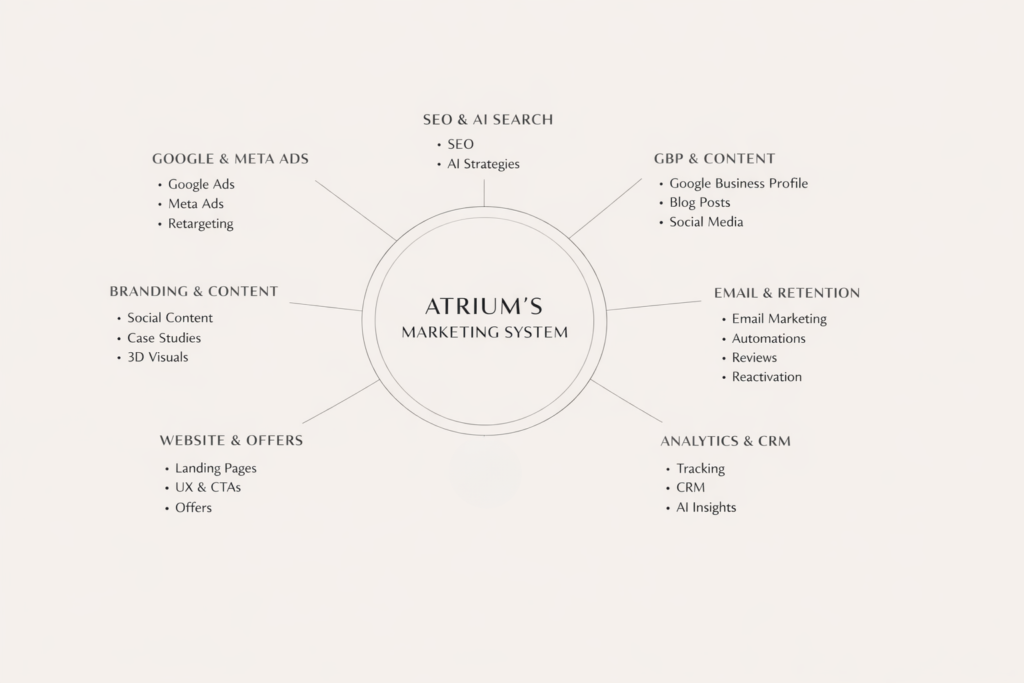
What a Real Marketing System Looks Like

At ATRIUM Creative Agency, we don’t ask:

“Which ads do you want?”

We ask:

How should your business generate demand year-round?

A proper system includes:

1. Demand Capture

Structured Google Ads campaigns targeting profitable services.

2. Demand Creation

Meta campaigns building visibility and trust before competitors appear.

3. Conversion Optimization

Landing pages designed to turn clicks into booked jobs.

4. Retention Systems

Email reminders, seasonal campaigns, and customer reactivation.

5. Authority Positioning

Content, visuals, and branding that reduce price shopping.

You can see how structured marketing impacts results in our Case Study for a Chimney Business


Why Hiring an Internal Marketing Team Often Fails

Many growing companies consider hiring:

A marketing manager
A social media person
An ads specialist

But quickly discover the reality:

Salary
Benefits
Training
Software
Management time

And still no full strategy.

One person rarely covers ads, branding, analytics, automation, and strategy effectively.


Your In-House Marketing Department, Without the Overhead

This is where our model is different.

ATRIUM operates as your in-house, out-of-house marketing department.

We integrate with your business like a team member.

We:

✔ Build strategy
✔ Manage advertising
✔ Implement systems
✔ Track performance
✔ Optimize continuously

You focus on operations and service delivery.

We handle marketing execution.

No payroll expansion.
No internal management burden.
No fragmented vendors.

Just one aligned team.


The Goal Is Not More Ads

The goal is stability.

When marketing works correctly:

You know where leads come from.
Slow season becomes predictable.
Revenue stops feeling reactive.

Ads become part of an engine, not emergency spending.


Final Thought

If you’re deciding between Google Ads and Meta Ads, you’re asking the right question.

But the better question is:

Do you have a marketing system working behind them?

Because platforms change.

A strong system keeps producing results regardless.

And that’s exactly what we build.

slow season marketing strategy for home service companies

Slow Season Marketing Strategy for Home Service Companies

Every year it happens.

Calls slow down.
The calendar starts opening up.
You look at payroll and start wondering where next month’s jobs will come from.

For many owners, the first reaction is simple:

Increase the ad budget.

But a proper slow season marketing strategy for home service companies is not about spending more money on ads.

It’s about building a system that keeps leads coming in even when demand drops.


Why Most Home Service Companies Struggle During Slow Season

The real issue during slow season is not traffic.

It’s structure.

Many home service companies depend on:

• Referrals
• Google Ads
• Reviews
• Busy season momentum

This works when demand is high.

But when slow season arrives, there is no pipeline, no follow-up system, and no predictable lead flow.

Ads become a temporary fix instead of a long-term strategy.


What a Slow Season Marketing Strategy Actually Means

A strong slow season marketing strategy for home service companies focuses on inbound demand instead of panic spending.

Inbound leads happen when customers find you naturally because your marketing system is working together.

That includes:

• A fully optimized Google Business Profile
• Service pages built for search visibility
• Educational website content
• Ongoing customer communication
• Strong online authority

Inbound marketing creates stability.

Once built, it keeps working even when you are focused on operations.


Demand Generation Without Relying Only on Ads

Ads are important, but they should support your strategy, not replace it.

A structured approach includes:

• Service-specific Google Ads campaigns
• Retargeting previous visitors
• Regional service pages
• Weekly Google Business Profile updates

👉 Example: Businesses improving visibility through proper GBP optimization often see consistent discovery traffic (see Google’s official GBP guidance: https://support.google.com/business).

This creates demand instead of chasing it.


Conversion Optimization: Where Most Revenue Is Lost

Getting clicks is only half the job.

When customers land on your website, they should immediately see:

• Clear service offers
• Trust indicators
• Financing or package options
• Proof of real projects

If every company looks the same online, customers compare price.

When positioning improves, customers compare value instead.

You can see how structured positioning impacts results in our
Flue Tech marketing case study


Retention Is the Real Slow Season Fix

The strongest slow season marketing strategy focuses on existing customers.

Instead of relying only on new leads, successful companies build:

• Maintenance programs
• Seasonal reminders
• Reactivation campaigns
• Review generation systems

Selling to past customers costs almost nothing compared to acquiring new ones.

If your database exists but isn’t being used, revenue is being left on the table.


Authority Positioning for Luxury Home Service Companies

Luxury service providers should not compete like commodity contractors.

Authority is built through:

• Educational content
• Before-and-after visuals
• Real project documentation
• Consistent messaging

When trust increases, price objections decrease.

This is why branding and visualization also play a role in marketing performance.

See how authority positioning supports large projects in this church capital campaign case study


The Slow Season Plan That Works

When slow season begins, we focus on:

• Reactivating past customers
• Promoting preventive services
• Booking future work early
• Increasing average ticket value
• Strengthening visibility before peak demand

Instead of reacting to slow months, the business becomes predictable.


What This Means for Business Owners

You should not have to:

• Wonder where leads come from
• Guess if ads are working
• Manage marketing tools
• Write campaigns yourself
• Track performance manually

Your role is operations.

Our role is marketing execution.

At ATRIUM, we operate as an extension of your team by designing, building, and managing the complete marketing system.


The Real Shift

Most companies buy revenue month by month.

High-performing operators build marketing assets.

A complete slow season marketing strategy for home service companies turns marketing from stressful into controlled growth.


If Slow Season Is Stressing You Out

Before increasing your ad budget again, ask:

Do I have a retention system?
Is my Google presence optimized?
Are my offers structured clearly?
Do customers see authority or just pricing?

If not, that’s where strategy starts.

And that’s exactly what we build.

How AI Search Is Changing the Way Clients Find You (and How to Stay Visible)

Search is evolving, and AI tools are now recommending brands, services, and studios directly. If your visibility feels flat, the issue isn’t demand, it’s how people are discovering. This guide shares how ATRIUM helps design-driven businesses stay visible and trusted across AI platforms, globally.On this page

AI Discovery: The New Way Clients Find You

AI platforms like ChatGPT, Perplexity, and Google’s AI experiences are acting as digital advisors. They synthesize, compare, and recommend, not just list links. These systems prefer content that is specific, verifiable, and consistent. Generic statements like “quality service” or “innovative solutions” are ignored, clear proof wins.

For design-led businesses, the opportunity is simple, speak clearly about outcomes, demonstrate expertise with first-hand evidence, and make your brand easy to recognize across the web.

ATRIUM’s Five-Pillar Framework

1) Brand Clarity

AI systems identify entities, not just keywords. Define your brand with consistent language, visuals, and positioning everywhere. If you specialize in high-fidelity 3D visualization or brand systems for architects, say it the same way across your site, profiles, and features. Consistency helps AI understand who you are and when to recommend you.

2) Service Specificity

Specific services outperform generic labels. Replace broad terms with clear, outcome-focused descriptions, for example, “Cinematic architectural renderings built to secure faster approvals and investor confidence,” or “360° project experiences for pre-sales and leasing campaigns.” Create proprietary names where relevant, such as “Signature Visualization” or “Architect’s Preview Render,” and use them consistently.

3) First-Party Proof

Publish insights only you can provide, real project breakdowns, timelines, measurable results, process documentation, and lessons learned. Case studies and data points signal authority. AI systems favor sources with original expertise over summaries that anyone can produce.

4) Third-Party Credibility

What others say about you matters. Earn mentions through features, directories, partner pages, and associations. Encourage clients to share public testimonials and project credits. A distributed footprint helps AI connect references back to your brand and increases the likelihood of being recommended.

5) Integration Over Isolation

Treat visibility as an ecosystem. Brand clarity supports authority, authority attracts mentions, mentions build trust, trust drives recommendations. Start with your strongest pillar, shore up the weakest, and maintain a consistent standard across all touchpoints.

Related ATRIUM pages:

Why Acting Now Matters

Most teams still optimize only for traditional search, yet clients are already researching with AI every day. Early movers set the standard, secure references across platforms, and become the default recommendation when prospects ask for the best partner in their category.

If you want AI to recommend your brand for architectural visualization, branding, or web design, build clear signals, share first-hand expertise, and earn credible mentions. The advantage compounds over time.

Get a tailored AI-visibility plan

In one consult, we’ll audit your current footprint, identify quick wins, and map a practical plan for international reach.

Schedule a call with ATRIUM

FAQs

How is AI search different from traditional SEO?

Traditional SEO targets ranked lists, AI search synthesizes and recommends. Clear brand definitions, first-party proof, and third-party credibility play a bigger role than ever.

What type of content does AI trust?

Original insights, project data, timelines, measurable outcomes, and expertise from credible sources. Summaries without evidence are less effective.

How fast can results show?

Timelines vary by footprint. Brands with consistent language, live case studies, and existing mentions see quicker movement. The earlier you standardize signals, the better.

Can ATRIUM help with international reach?

Yes. ATRIUM aligns your services, case studies, and website to match AI discovery patterns, then supports authority with targeted features and consistent brand language across markets. From ATRIUM, your boutique creative partner for 3D visualization, branding, and web design.

Google Ads Account Security Audit: How We Prevented a $70K Loss

When a new client asked us to review their digital advertising, we started with a Google Ads account security audit.

What we discovered was not a performance issue.

It was a serious security risk.

Multiple ad accounts had been created over time.
Too many users had full admin access.
There were no centralized permissions or protection protocols.

Even gaining access took time.

But once inside, we realized ads had been running unchecked, spending nearly $6,000 per month beyond the intended budget.

And that was only the beginning.


When Poor Account Security Turns Into Real Financial Loss

Shortly after access was granted, the account was hacked.

Because admin permissions had never been cleaned up, unauthorized users were able to launch malicious campaigns.

Within three days:

• Three fraudulent ads launched
• Budgets overridden
• Nearly $70,000 in ad spend accumulated

This wasn’t a targeting problem.

It was a setup problem.

According to Google’s own account protection guidelines, limiting admin access is one of the most critical security steps for advertisers.
👉 https://support.google.com/google-ads/answer/6372672


Acting Fast: Containing the Damage

We immediately escalated the issue to Google’s billing and security teams.

At the same time, we:

• Paused compromised campaigns
• Initiated a full investigation
• Documented unauthorized activity
• Built a clean backup advertising account
• Relaunched campaigns to maintain lead flow

The client never lost momentum during peak season.

✅ Final result: $70,000 fully refunded.


The Real Issue Was Not Advertising Performance

Most conversations around Google Ads focus on:

Keywords
Headlines
Bidding strategies

But a proper Google Ads account security audit looks deeper.

Marketing success depends on:

✔ Account structure
✔ Permission control
✔ Platform integrations
✔ Data ownership
✔ Security oversight

Without these foundations, even successful campaigns are vulnerable.


Why Marketing Security Extends Beyond Google Ads

The same risks apply across your entire digital ecosystem:

• Social media accounts
• Website hosting
• Domains
• Email marketing platforms
• Analytics tools
• CRM systems
• Design software
• File sharing access

One weak access point can compromise everything.

This is why we approach marketing as infrastructure, not isolated campaigns.

You can see how structured systems impact long-term performance in our
👉 Flue Tech marketing case study
https://atriumvisual.studio/client-spotlight-flue-tech-inc/


Simplifying Access Without Sacrificing Security

Most business owners don’t have time to track passwords across ten platforms.

So we simplify the process.

ATRIUM uses secure integration tools that allow controlled access without sharing sensitive credentials.

No spreadsheets.
No outdated logins.
No operational risk.

Just a secure, centralized system.


Why Every Business Needs a Google Ads Account Security Audit

If multiple agencies, employees, or contractors have accessed your marketing accounts over time, risks accumulate quietly.

A professional Google Ads account security audit ensures:

• Correct ownership setup
• Restricted admin access
• Secure integrations
• Budget protection
• Long-term operational control

Security is not optional once advertising budgets scale.


Final Takeaway

Strong marketing starts with strong foundations.

Strategy matters.
Creative matters.
Targeting matters.

But none of it works without proper setup and protection.

Saving this client $70,000 was not luck.

It was structure.

And that’s exactly how we approach every marketing system we manage.